
Learn to identify and use natural tinder for fire lighting
Fire Tinder Identification – Natural Tinder for Scout Bushcraft
Learning fire tinder identification and prepare natural tinder is an important bushcraft and Scout fire-lighting skill. Tinder is the first stage of a fire: it needs to catch a flame or spark easily and burn long enough to ignite your kindling.

What is tinder?
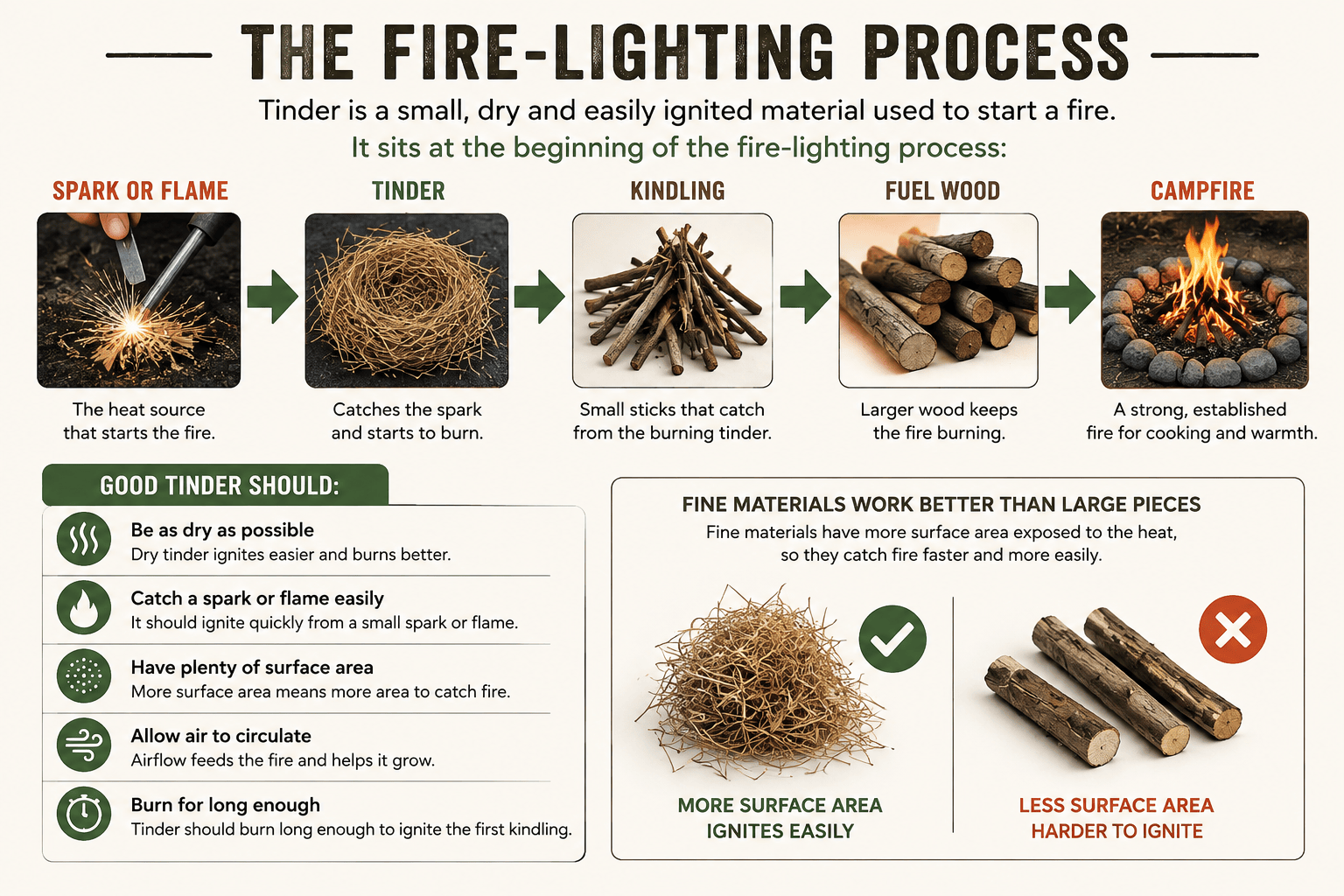
Tinder is a small, dry and easily ignited material used to start a fire.
It sits at the beginning of the fire-lighting process:
Spark or flame → Tinder → Kindling → Fuel wood → Campfire
Good tinder should:
- Be as dry as possible
- Catch a spark or flame easily
- Have plenty of surface area
- Allow air to circulate
- Burn for long enough to ignite the first kindling
Fine materials generally work better than large pieces because they have more surface area exposed to the heat.
What Makes Good Tinder?
Good tinder is fine, dry material that ignites easily from a flame or sparks and burns long enough to transfer heat to the first pieces of kindling. The best tinder depends on the ignition method and conditions. A material that works well with a match may not be the best choice for flint and steel or a ferro rod.
| Tinder | Where to find it | How to prepare | Best way to use it |
|---|---|---|---|
| Birch bark | Birch trees, especially loose fallen bark | Tear into thin strips or scrape into fine fibres with a knife | Excellent for matches, ferro rods and flint & steel |
| Dry grass | Open grassland, woodland edges and fields | Rub and tease into a loose, fluffy bundle | Light the fine centre and feed the flame with small kindling |
| Straw | Farms, fields and dry areas | Break into short, fine pieces and make a loose nest | Good for flame-based fire lighting; burns quickly |
| Dry leaves | Woodland floor and under trees | Crush and break into small, dry pieces | Mix with finer tinder to help create a larger tinder bundle |
| Fine wood shavings | From dry wood | Shave very fine curls or fibres | Excellent for catching a flame and transferring it to kindling |
| Feather sticks | Made from dry sticks | Shave thin curls without cutting them away from the stick | Light the fine shavings and gradually build the flame |
| Pine needles | Under pine and other conifer trees | Gather dry needles and loosen them | Useful as part of a tinder bundle |
| Pine resin | Conifer trees and fallen branches | Use small amounts of naturally collected resin with dry tinder | Helps tinder burn longer and hotter |
| Cramp balls / King Alfred's cakes | Usually on ash and other hardwoods | Collect when dry; break or scrape if necessary | Can catch and hold an ember, useful with flint and steel |
| Punk wood | Dry, rotten wood and fallen branches | Break into fine, dry fibres | Useful for catching and holding an ember |
| Reed and rush fibres | Wetland edges and waterways | Dry thoroughly and tease apart | Make into a loose tinder bundle |
| Clematis bark | Dead or dry clematis stems | Strip and rub the fibres apart | Fine fibres can catch a flame or spark |
| Dead bracken | Woodland and heathland | Break into fine dry pieces | Useful when completely dry; works best mixed with finer tinder |
| Char cloth | Prepared from cotton fabric | Make beforehand by charring cloth in a low-oxygen container | Excellent for catching sparks and producing an ember |
Tinder for Flint and Steel or Ferro Rods
A tinder that works with a flame isn't necessarily the best tinder for a spark.
A ferro rod produces a shower of hot sparks, so very fine and easily ignited materials are particularly useful. Cotton wool is commonly used for Scout activities, while natural materials such as very fine birch bark and prepared tinder can also be used.
When using a ferro rod, the tinder should be positioned close to the sparks, with enough airflow to allow the first ember or flame to develop. Scouts' own flint-and-steel activity guidance recommends positioning the tinder close to the fire steel and directing sparks towards it.
Natural Tinder by Ignition Methods
Matches
Good choices include:
- Dry grass
- Birch bark
- Fine wood shavings
- Feather sticks
Ferro Rod
Best choices include:
- Very fine birch bark
- Fine dry grass
- Fine wood fibres
- Prepared tinder bundles
Flint & Steel
Best choices include:
- Char cloth
- Cramp balls
- Punk wood
- Very fine prepared natural tinder

Keeping Tinder Dry
Dry tinder is one of the secrets to successful fire lighting.
Even excellent tinder can fail if it has absorbed moisture.
Good habits include:
- Collect tinder before lighting the fire.
- Keep prepared tinder in a waterproof bag or container.
- Look underneath fallen material for dry fibres.
- Split or scrape damp material to find a dry interior where appropriate.
- Prepare more tinder than you think you will need.
- Keep your tinder away from rain and wet ground.
Preparation is particularly important when teaching fire lighting because repeatedly searching for tinder after a fire has been started can create unnecessary distractions.
Simple rule for Scouts
Fine tinder → catches the spark → burns into a flame → lights kindling → kindling lights fuel wood.
The key is to prepare the tinder before striking the first spark. Keep it dry, loose and airy, and have your kindling ready to add as soon as the tinder develops a flame.
The Natural Tinder Challenge
Engage in a hands-on activity that teaches Scouts to identify, prepare, and test various natural materials for fire lighting. This challenge enhances observational skills and practical knowledge.


To run a scout tinder-identification and collection exercise in small patrols, divide your troop into groups, hand out printed reference sheets of natural and artificial tinders, and set a timed challenge to correctly forage, identify, and use them to spark a fire.
Other Ideas for Scouts Learning Tinder ID...
Making a Natural Tinder Bundle
A simple tinder bundle is an excellent Scout bushcraft activity.
1. Find dry material
Collect a mixture of fine dry grass, thin bark, dry leaves, fine wood shavings or other suitable natural materials.
2. Separate the fibres
Tease the material apart so it becomes loose and fluffy.
3. Build a nest
Shape the material into a loose ball or bird's-nest shape.
4. Add fine tinder
Place your finest and easiest-to-light material in the centre.
5. Leave an opening
Keep the bundle loose enough for air to move through it.
6. Light the centre
Use an appropriate fire-lighting method and introduce the flame or sparks carefully.
Once the tinder is burning strongly, transfer the flame to your prepared kindling.
Natural Tinder Challenge for Scouts
Why not turn tinder identification into a bushcraft activity?
Give Scouts a selection of natural materials and ask them to:
- Identify each material.
- Decide whether it is tinder, kindling or fuel.
- Explain whether it needs to be dried or prepared.
- Predict which materials will catch a spark.
- Make a tinder bundle.
- Test their tinder under controlled supervision.
- Explain what made their tinder successful or unsuccessful.
This can make an excellent Scout bushcraft fire-lighting activity and can be combined with woodland identification and fire-safety skills.
Tinder Identification Challenge
Try collecting or displaying examples of:
- Birch bark
- Dry grass
- Dry leaves
- Fine wood shavings
- Feather sticks
- Cramp balls
- Punk wood
- Pine needles
- Small dry twigs
- Prepared char cloth
Ask Scouts to identify each material and rank them from easy to difficult to ignite.
The challenge isn't simply finding something that burns. The real bushcraft skill is learning which material works best for the conditions and the ignition method being used.

How to Make Charcloth
Char cloth is made by heating 100% natural fiber fabric (usually cotton) in a container with very little oxygen. This process, called pyrolysis, turns the fabric into carbon without letting it burn to ash.
You'll need:
- 100% cotton cloth (an old T-shirt, bandana, or denim works well)
- A small metal tin with a tight-fitting lid (an Altoids-style tin is popular)
- A nail or drill to make one tiny vent hole (about 1–2 mm)
- A campfire, grill, or gas stove
- Tongs or pliers
- Twig with point cut to block the hole
Steps:
- Cut the cotton into pieces that fit inside the tin.
- Make a small vent hole in the lid and place the cloth inside. Close the lid.
- Put the tin over a fire or burner.
- Smoke (and sometimes a small flame) will come out of the vent hole. That's normal as gases escape.
- When the smoke stops—usually after about 5–15 minutes—remove the tin from the heat and plug the hole with a pointed twig.
- Let it cool completely before opening it. Opening it while it's still hot can let oxygen in and cause the cloth to burst into flame.
- The finished char cloth should be completely black, soft, and hold together. If it's brown in places, heat it a little longer. If it crumbles into gray ash, it was overheated.
To use it, catch a spark from flint and steel or a ferrocerium rod on the char cloth. It will glow like an ember. Place it in a dry tinder bundle and gently blow until the bundle ignites.
Safety tips:
- Make it outdoors or in a well-ventilated area—the smoke is unpleasant and flammable.
- Use only natural fibers; synthetic fabrics melt instead of charring.
- Handle the hot tin with tongs or heat-resistant gloves.
If you're interested, I can also show you how to make char cloth without a tin using only a campfire and foil.
Other Links
Scouing Links
Location: Essex