
Sweet Chestnut Tree Identification and Bushcraft
Sweet Chestnut is a familiar woodland tree, particularly in southern England, where it has been widely managed as coppice. It is an excellent tree for Scouts to learn to identify because it has distinctive leaves, bark and fruit, while its timber has many traditional bushcraft and woodland uses.
Sweet Chestnut was introduced to Britain, traditionally associated with Roman introduction, and is now well established in many parts of the country.
How to Identify Sweet Chestnut
Leaves
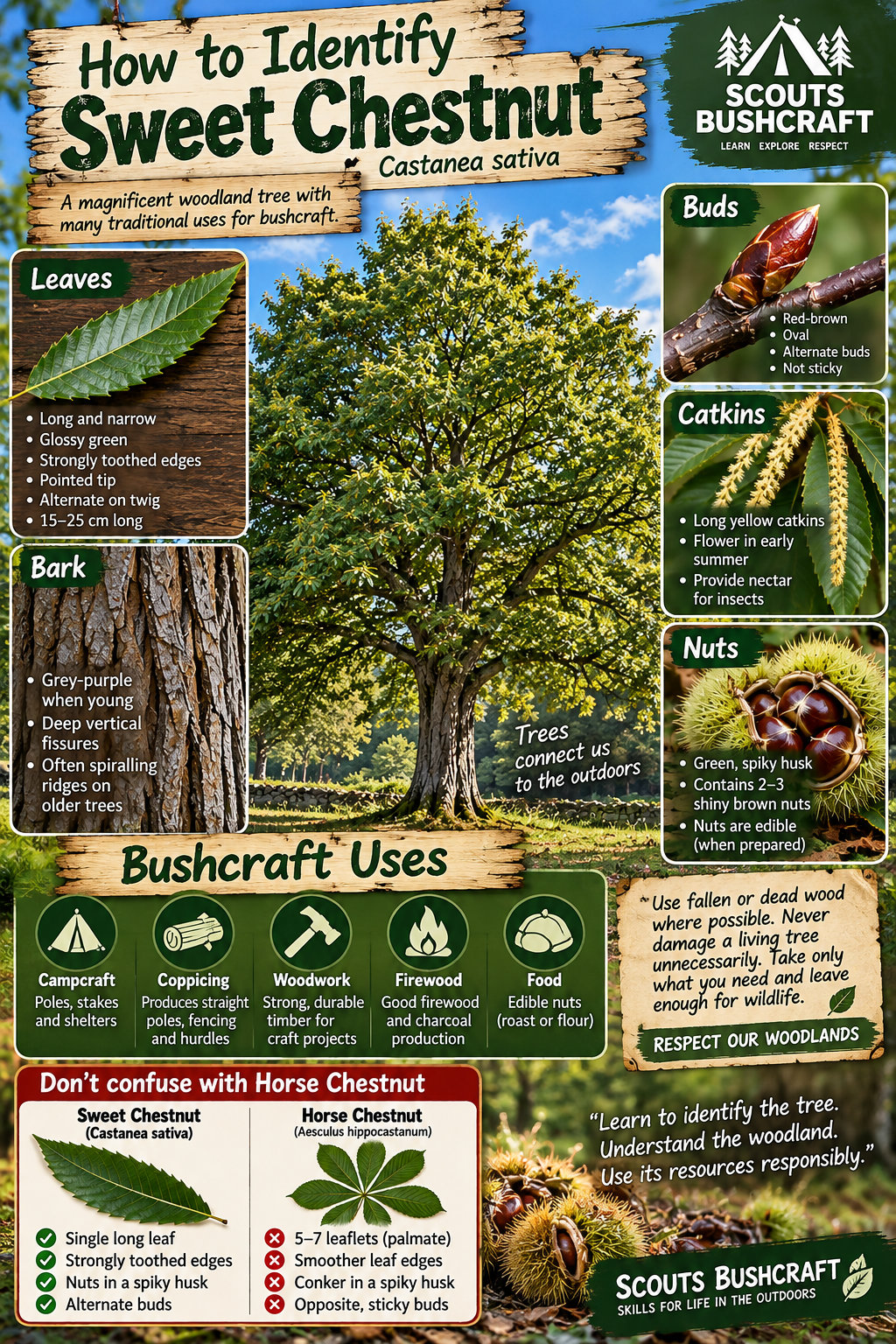
The leaves are one of the easiest ways to recognise Sweet Chestnut.
- Long, narrow and glossy green
- Usually around 15–25 cm long
- Pointed tip
- Prominent central vein
- Clearly toothed or serrated edges
- Leaves are arranged alternately along the twig
- Turn yellow or golden before falling in autumn
The large, pointed, saw-toothed leaves are particularly useful when distinguishing Sweet Chestnut from Horse Chestnut.
Bark
Young trees have relatively smooth, grey-purple or silvery bark.
As the tree gets older, the bark develops deep vertical fissures and ridges. On older trees, these fissures can develop a distinctive spiralling or corkscrew appearance around the trunk.
Flowers
Sweet Chestnut flowers in early summer, producing long yellowish catkins.
The flowers provide an important source of nectar and pollen for bees and other insects.
Nuts
The familiar Sweet Chestnut develops inside a green, spiky husk.
The nuts are smaller and differently shaped from Horse Chestnut conkers. Sweet Chestnut nuts are edible when properly prepared and can be roasted or ground into flour.
Sweet chestnut seeds are edible and commonly roasted to eat, whereas horse chestnut seeds (known as conkers) are toxic and can make humans and animals very ill.
🌿 Easy Scout memory trick
Sweet Chestnut = ONE long, toothed leaf.
Horse Chestnut = MANY leaflets like fingers on a hand.
⚠️ Don't eat a nut simply because you think you've identified it as a chestnut. Correct identification is essential, and wild foods should only be eaten when you are certain of the species and safe preparation.

Sweet Chestnut Bushcraft Uses
Sweet Chestnut is particularly interesting from a bushcraft perspective because it has traditionally been managed as coppice.
Coppicing involves cutting suitable stems close to ground level so that the stool produces multiple new shoots. Sweet Chestnut responds well to this method and can produce long, straight poles.
🪵 Poles and Campcraft
Straight coppiced Sweet Chestnut poles can be useful for:
- Camp structures
- Shelters
- Framework
- Stakes
- Pegs
- Garden and woodland structures
- Rustic furniture
- Hurdles and fencing
Sweet Chestnut coppice has traditionally been used for fencing, poles and other small roundwood products.
🔥 Firewood and Charcoal
Sweet Chestnut has traditionally been used for firewood and charcoal production.
Its historic use in coppiced woodland makes it a useful example when teaching Scouts about the relationship between woodland management, fuel and bushcraft.
🪓 Working the Wood
Sweet Chestnut produces a strong, durable timber that is relatively lightweight and easy to work.
It has traditionally been used for:
- Joinery
- Carpentry
- Furniture
- Fencing
- Posts
- Roof beams
- Rustic structures
The wood can also split along the grain, making suitable coppiced material useful for rails and other woodland products.
🍴 Food
The Sweet Chestnut nut is edible, unlike the conker from a Horse Chestnut.
Chestnuts can be roasted or processed into flour. For Scouts, this makes Sweet Chestnut an interesting example of how tree identification can connect woodland knowledge with traditional food skills.
Always make absolutely certain that the tree has been correctly identified before eating anything gathered from the wild.
🔥 Sweet Chestnut for Scout Bushcraft
Sweet Chestnut makes a great teaching tree because one species can introduce several bushcraft subjects:
🌳 Tree identification – leaves, bark, buds and nuts
🪓 Woodcraft – understanding timber and how it can be worked
🏕️ Campcraft – poles, stakes and structures
🔥 Fire lighting – understanding different firewood species
🌿 Coppicing – sustainable woodland management
🍴 Wild food – learning about edible tree products
♻️ Woodland conservation – using natural resources responsibly
Rather than simply learning the name of a tree, Scouts can discover how people have traditionally worked with the woodland around them.
🌿 A Bushcraft Lesson Idea
Challenge your Scouts: Find a Sweet Chestnut and identify it using at least three different features.
Can they identify it from:
- The leaves?
- The bark?
- The buds?
- The catkins?
- The nuts or husks?
- The shape of the tree?
Then ask them:
“If you were managing this woodland for bushcraft, what could Sweet Chestnut provide?”
The answers could include poles, stakes, fencing, firewood, charcoal, timber and food.

⚠️ Woodland & Tree Health
Sweet Chestnut is affected by pests and diseases, including Sweet Chestnut blight. Current UK guidance encourages people to look out for unusual symptoms such as damaged or sunken bark, cracking or peeling areas and declining foliage. Suspected tree-health problems can be reported through the official TreeAlert system.
When practising bushcraft, remember:
Leave living trees alone unless you have permission to manage them.
Use suitable fallen wood or material from an authorised woodland management operation, and follow the principles of Leave No Trace and responsible woodland management.
🌳 Scouts Bushcraft
Sweet Chestnut is much more than a tree to identify. It is an excellent example of the connection between trees, traditional woodland management, bushcraft and sustainable outdoor skills.
Learn to identify the tree. Understand the woodland. Use its resources responsibly.
Explore more UK tree identification and bushcraft skills at Scouts Bushcraft.
My Links
Scouing Links
Location: Essex