
Natural Navigation for Scouts
Natural navigation is the skill of finding your way by observing the world around you rather than relying entirely on a map, compass, GPS, or phone. People have used these methods for thousands of years when travelling through woodland, countryside, mountains, and along the coast.
In bushcraft and Scouting, natural navigation is not about replacing modern navigation tools; it is about becoming more aware of your surroundings and understanding the clues that nature provides.
Sun Navigation
Learn to use the sun's position to determine direction and time.
Star Navigation
Navigate the night sky with confidence using constellations.

Common Natural Clues
- The Sun – In the UK the sun rises roughly in the east and sets roughly in the west. Around midday it is generally in the southern part of the sky.
- Shadows – A stick placed upright in the ground will cast a moving shadow that can help estimate direction.
- The Moon – The moon’s position can give a rough sense of direction at night, although it changes throughout the month.
- Stars – The Pole Star (Polaris) sits almost due north in the northern hemisphere.
- Wind and weather – Trees, hedges, and vegetation may show the effects of prevailing winds.
- Water flow – Streams usually flow downhill and can help identify valleys and lower ground.
- Vegetation – Plants often grow differently on sunny and shaded sides, though this should only be treated as a supporting clue.
- Human features – Field boundaries, paths, tracks, church towers, pylons, and road noise can all help you build a picture of where you are.

Important Safety Point
Natural signs are rarely accurate on their own. Moss does not reliably grow only on the north side of trees, and no single clue should be trusted in isolation. Always use several observations together and carry proper navigation equipment when walking or camping.

Why learn natural navigation?
- Builds observation skills.
- Increases confidence outdoors.
- Helps you understand the landscape.
- Provides a useful backup if equipment fails.
- Encourages a closer connection with nature.
Natural navigation is best thought of as reading the landscape. The more time you spend outdoors paying attention to the sun, wind, ground, water, plants, and landmarks, the easier it becomes to recognise direction and understand where you are.
Essential Natural Navigation Skills
Using the Sun
Master the art of determining direction and time by observing the sun's movement across the sky.
Reading the Stars
Identify key constellations to guide your path during nighttime adventures.
Landmark Navigation
Utilize natural and man-made landmarks to maintain your course and find your way.
Weather Interpretation
Learn to predict weather changes by observing cloud formations and wind patterns.
Map and Compass Skills
Enhance your navigation accuracy with traditional map and compass techniques.
Animal Tracking
Develop the ability to read animal tracks and signs to understand wildlife movements.
Some of the Methods...

Sun Navigation
The sun can help you estimate direction during daylight. In the UK it rises roughly in the east, is generally in the south around midday, and sets roughly in the west. A simple stick-and-shadow sundial or an analogue watch used as a sun compass can provide a rough guide, but these methods are only approximate. Always check your direction with a map and compass and use several observations together when navigating outdoors.

Star Navigation
Stars can help you find direction at night. In the UK and the Northern Hemisphere, the Pole Star (Polaris) sits almost directly above north. Find the Big Dipper (Ursa Major), follow the two stars at the end of its bowl, and extend that line to locate Polaris. Star navigation is a useful backup skill, but always confirm your direction with a map and compass.

Sundial Method
-
Push a straight stick into level ground.
-
Mark the tip of the shadow with a small stone.
-
Wait about 15–20 minutes and mark the new shadow tip.
-
Draw a line between the two marks.
-
In the UK, the first mark is roughly west and the second mark is roughly east.
-
Stand with the first mark on your left and the second on your right; you are facing roughly north.
Best for: learning how the sun appears to move across the sky.

Sun Compass Method
-
Note where the sun is in the sky.
-
In the UK, the sun is generally in the east during the morning, roughly south around midday, and in the west during the evening.
-
Use nearby landmarks to keep your chosen direction.
Important: The sun is rarely exactly east or west except around the equinoxes, so treat this as a rough guide.
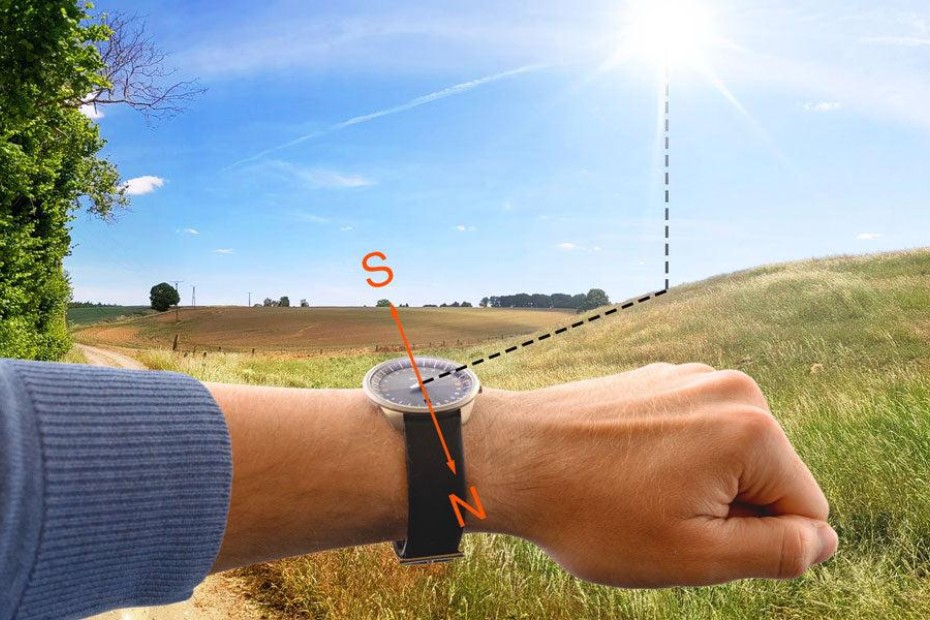
Analogue Watch Compass Method
Northern Hemisphere (UK)
Hold the watch flat.
Point the hour hand directly at the sun.
Find the halfway point between the hour hand and the 12 o’clock mark.
That halfway line points roughly south; the opposite direction is roughly north.
Example
If it is 4:00 pm, point the hour hand at the sun. Halfway between 4 and 12 is about 2 o’clock, and that direction is roughly south.
For daylight saving time (British Summer Time): many instructors use the halfway point between the hour hand and 1 o’clock for a better approximation.
Other Links
Scouing Links
Location: Essex